
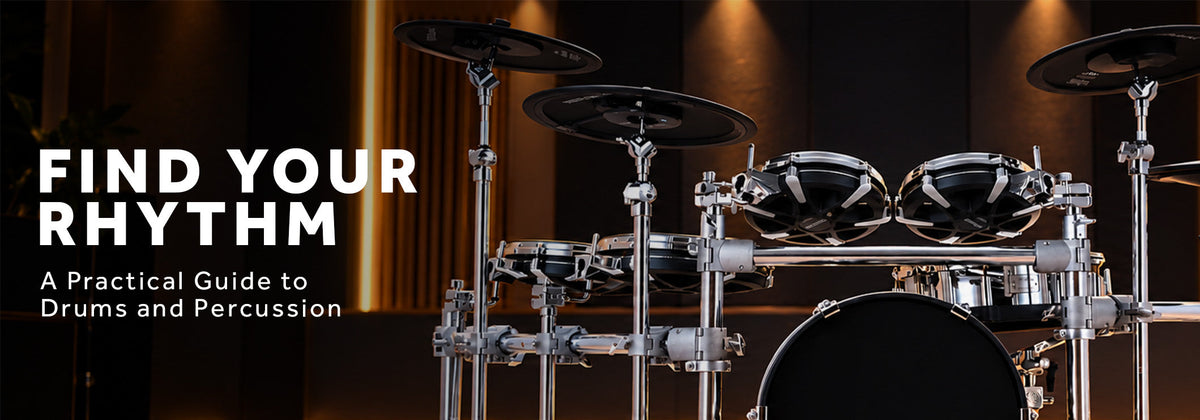
Drums and Percussion Instruments: A Practical Guide for Every Player
About this guide: Written by the Austin Bazaar Editorial Team to help musicians, parents and teachers understand drums, percussion instruments and accessories, and what to weigh when choosing them.
All drums are percussion instruments, but most percussion instruments aren't drums. A drum makes sound with a stretched head, like a snare or a bongo. Percussion is the whole family of instruments you strike, shake or scrape, which also includes cymbals, a tambourine, a cajon and a xylophone.
That distinction matters more when you're buying than it sounds. Someone shopping for "drums" might really need a cajon for an acoustic duo. A parent whose child has been told to bring "percussion" for school band may actually need a practice pad and a bell kit, not a drum set.
If you want the short answer on where to start, here it is. For players learning styles such as rock, pop, worship or jazz, a drum kit is usually the most versatile starting point. Choose acoustic if you have the space and the neighbors for it, and electronic if you don't. If you want rhythm without a full kit, a cajon or a pair of bongos offers a simpler way to start playing rhythms without committing to a full kit. The rest of this guide explains why, and what to look for at each step.
Drums vs Percussion: What the Words Actually Mean
Musicologists split percussion into two broad groups, and the split makes shopping easier.
Membranophones make sound with a vibrating skin or membrane. That covers every drum: kick, snare, toms, bongos, congas and djembes. Today most drumheads are plastic film rather than animal hide, but the principle hasn't changed.
Idiophones make sound by vibrating their own body. Cymbals, cowbells, shakers, tambourine jingles, glockenspiel bars and the front plate of a cajon all belong here.
There's a second split worth knowing: pitched versus unpitched. A xylophone plays specific notes, so you read melodies on it. A snare drum doesn't. Toms can be tuned higher or lower, but they don't play a scale. That's why school band programs teach mallet percussion and snare drum as separate skills.
In a store, "drums and percussion" usually covers four areas: drum kits (acoustic and electronic), cymbals, hardware and accessories, and everything played outside the kit, from hand drums to mallet instruments.

What's Actually in a Drum Kit
A drum kit, also called a drum set, is a group of drums and cymbals arranged so one person can play them all at once, hands and feet together. Kit listings describe size by counting drums. A "five-piece" kit has five drums. Cymbals aren't counted.
|
Part |
What it does |
Typical size |
|
Bass drum (kick) |
The low pulse, played with a foot pedal |
20" or 22" diameter |
|
Snare drum |
The sharp backbeat; wires under the bottom head buzz when struck |
14" diameter, about 5"–6.5" deep |
|
Rack toms |
Higher-pitched fills, mounted above the kick or on stands |
10" and 12", or 12" and 13" |
|
Floor tom |
The deepest tom, standing on its own legs |
14" or 16" |
|
Hi-hats |
Two cymbals on a stand, opened and closed with the left foot |
13" or 14" |
|
Crash |
Accents and section changes |
16"–18" |
|
Ride |
Steady patterns, especially in jazz and quieter songs |
20"–22" |
Why the snare matters most
The snare deserves particular attention because it carries the backbeat in so much popular music, so your ears focus on it more than on anything else in the kit. A cheap kit with a well-tuned snare often sounds better than a nicer kit with a choked, ringing one. For players upgrading one piece at a time, the snare is often a natural place to start because it plays such a prominent role in the kit's sound.
Shell sizes and what they change
Bigger diameters sound lower and fuller. Deeper shells add body and sustain. That's why rock players lean toward a 22" kick, while jazz players often like an 18" or 20" kick with smaller toms that sing higher. For most beginners, a standard "fusion" or "rock" configuration covers nearly every style well enough, so shell sizes rarely need to drive a first purchase.
Drumheads matter almost as much as the shells. A single-ply head is open and bright. A two-ply head is warmer and more durable, and it takes heavy hitting better. Factory heads on entry kits are usually basic, so new heads are one of the cheapest real upgrades you can make.
Acoustic vs Electronic Drums
This is the decision most new drummers spend the longest on, and it usually comes down to where you live rather than what you like.
|
Acoustic kit |
Electronic kit |
|
|
Volume |
Loud. Plan on hearing protection and understanding neighbors |
Pads are quiet; you hear the sound through headphones or an amp |
|
Space |
Needs a dedicated corner, plus room for cymbal stands |
Folds into a smaller footprint on a single rack |
|
Feel |
Real stick rebound, cymbal swell, dynamics |
Mesh heads feel close to real drums; cymbals feel less natural |
|
Sound options |
One kit, shaped by tuning, heads and cymbals |
Many kit sounds built into the drum module |
|
Practice tools |
Add a metronome |
Metronome, recording and play-along features usually built in |
|
Recording |
Needs microphones and a decent room |
Plug in over USB or MIDI and record straight into software |
|
Gigging |
Common choice for many live bands |
Common in worship bands and tight stages |
Who should choose acoustic
If you have a basement, a garage or a detached space, acoustic is still the better teacher. You learn to control your volume with your hands instead of a knob. Cymbals respond to how you strike them. The kit pushes back. Players who plan to join a band or take jazz seriously will eventually want that feedback.
Who should choose electronic
Apartment renters, families with young kids asleep down the hall, and anyone who practices late will get far more playing time out of an electronic kit. Hours actually spent at the kit matter more than any feature, so the quiet option often wins on its own.
When comparing electronic drum kits, look first at the pads. Mesh heads let you adjust tension and feel springy, close to an acoustic drum. They're also much quieter acoustically. Rubber pads cost less but feel harder, and they make a louder thud you can hear in the room. The second thing to check is the drum module, the small brain that holds the sounds. A good one includes a metronome, a coach or practice mode, a headphone output and USB for recording. Brands such as Roland have built their electronic drum lines around both features.
Keep in mind that electronic drums are quieter, not silent. The bass drum pedal still sends a thump through the floor. If someone lives below you, a riser or a layer of dense foam under the kit matters more than which kit you buy.
A good pair of closed-back headphones is a useful addition to an electronic setup. Closed-back models keep the sound in your ears and block more of the acoustic tap from the pads.
Cymbals: Where a Kit Gets Its Personality
Two kits with identical drums can sound like different bands depending on the cymbals. Beginners tend to underrate them, partly because entry kits often ship with cheap ones and partly because cymbal names are confusing.
|
Cymbal |
Role |
Sound |
|
Hi-hats |
Timekeeping: steady eighth notes, open "barks," foot "chicks" |
Tight and crisp closed; washy when open |
|
Ride |
Timekeeping over louder or quieter sections; bell for accents |
Defined "ping" with a wash underneath |
|
Crash |
Accents, downbeats of a chorus |
Quick explosive burst that decays fast |
|
Splash |
Small, fast accents |
Short, bright and gone |
|
China |
Trashy accents, common in rock and metal |
Harsh, dark and aggressive |
For a basic cymbal setup bought one piece at a time, start with hi-hats, then add a ride and a crash. With those three you can play almost anything. Splashes and Chinas are seasoning.
Why cymbal metal matters
The alloy is a big part of why cymbal prices vary so much. B20 bronze is about 80% copper and 20% tin, and it's the traditional cast-bronze alloy behind lines such as Zildjian's A and K series. It tends toward a darker, more complex sound. B8 bronze is about 92% copper and 8% tin, and it usually sounds brighter and more focused. It's common in entry and intermediate cymbals, though some professional lines use it too (Modern Drummer's alloy guide covers the range). Alloy is only one factor, though. Size, weight, shape, hammering and lathing shape a cymbal's sound just as much. Brass cymbals often come with the most affordable starter kits. They're fine for learning, and for many beginners, upgrading from them makes a noticeable difference in the overall sound of the kit.
A boxed cymbal pack that matches hi-hats, a crash and a ride is usually the most cost-effective upgrade from a starter kit. You can compare options on our cymbals for every setup page, including lines from Zildjian.

Drum Hardware and Pedals
Hardware is everything metal that holds the kit together and lets you play it: the bass drum pedal, hi-hat stand, snare stand, cymbal stands, tom mounts and the throne you sit on. It isn't exciting, but poor-quality hardware can make a beginner kit feel unstable and uncomfortable to play. Stands creep, pedals feel mushy, and the seat wobbles.
The bass drum pedal
Your right foot (left, for left-handed players) spends the whole song on this pedal, so it affects your playing more than people expect. Pedals come in three common drive types:
- Chain drive feels slightly heavier and very consistent. Most players start here.
- Strap or belt drive feels lighter and quicker, and some players find it smoother at low volumes.
- Direct drive connects the footboard straight to the beater with a solid linkage. It responds instantly but takes more control.
Double pedals let you play the kick with both feet, which matters in metal and some gospel styles. A beginner doesn't need one.
Stands and the throne
Cymbal stands come as straight or boom stands. A boom has an arm that lets you place the cymbal over the drums, which is handy on crowded kits. Single-braced hardware is lighter to carry. Double-braced hardware is heavier and steadier under hard playing. A double-braced boom stand suits a permanent rehearsal setup. Gigging drummers who load in and out every weekend often go the other way, with a lightweight snare stand and matching cymbal stands.
Don't skimp on the throne. A properly adjusted throne, with your thighs roughly level or sloping slightly down, keeps you in a comfortable playing position and makes the pedals easier to control. A throne that won't hold its height undoes every other good habit.
You can see the range of stands, pedals and other drum hardware in one place if you're filling gaps in a kit.
Drumsticks and Practice Gear
Stick sizes use a number and a letter that are only loosely standardized between brands, but the order holds:
|
Size |
Feel |
Common uses |
|
7A |
Thin and light |
Jazz, quiet rooms, younger players |
|
5A |
Medium |
The default for most beginners and most styles |
|
5B |
Slightly thicker and heavier |
Rock, harder hitting, building wrist strength |
|
2B |
Thick and heavy |
Very loud playing, rudiment practice, marching-style work |
Start with 5A. If they feel flimsy or you keep dropping them, try a 5B pair. Nylon tips last longer and sound brighter on cymbals. Wood tips sound a little warmer but chip over time.
Two practice tools pay off more than any upgrade. A practice pad is a small rubber surface for working on hand technique almost silently, at a desk or on your knee. A metronome builds the steady time that bands care about more than speed. If your kit doesn't have one built in, add a metronome and use it every session.
Hand Percussion: Rhythm Without a Full Kit
Not everyone needs, or has room for, a drum set. Hand percussion fits acoustic sets, worship teams, classrooms and drum circles, and much of it is easy to start.
Cajon. A wooden box you sit on and play with your hands. Hitting near the center gives a deep, kick-like tone, and the top edge gives a sharp snare-like slap. Many cajons have snare wires inside for extra buzz. It developed in Afro-Peruvian communities on Peru's coast, and Peru declared the Cajón Peruano part of its national cultural heritage in 2001. It's now a staple of unplugged pop and worship music. Because it covers "kick and snare" in one box, it's the closest thing to a portable drum kit. A birch cajon is a popular way to start.
Bongos. Two small joined drums held between the knees, with a smaller, higher drum (macho) and a larger, lower one (hembra). They're central to Afro-Cuban music and work well for adding bright accents to acoustic songs. Browse bongos by size and finish.
Congas. Taller drums, usually played standing or seated in sets of two or three, from the higher quinto to the lower tumba. They have a fuller, deeper voice than bongos and anchor Latin grooves.
Djembe. A goblet-shaped drum from West Africa, played with bare hands. It produces a deep bass in the center and sharp slaps at the edge, and it's a common choice for community drum circles.
Small percussion. Tambourines, shakers and cowbells cost little and add a lot. A good shaker player makes a band sound tighter, and a tambourine on the chorus is one of the oldest tricks in pop production.
Concert and School Percussion
In US school band programs, "percussion" means something specific. Beginners usually learn snare drum technique on a practice pad and melody on a bell kit (a glockenspiel). Many programs rent or sell these together as a beginning percussion kit. Ask the band director for the exact list before buying, because requirements vary by school.
The two mallet instruments people confuse most are glockenspiels and xylophones:
|
Glockenspiel |
Xylophone |
|
|
Bars |
Metal |
Wood or synthetic |
|
Sound |
Bright, bell-like, sustains |
Dry, woody, short decay |
|
Pitch |
Sounds two octaves above written |
Sounds one octave above written |
|
Typical use |
Beginning band, orchestra color |
Orchestra, marimba-style parts, classrooms |
Pitch figures follow Yamaha's concert percussion catalog.
For younger kids and classroom music, small glockenspiels and xylophones are also a friendly first pitched instrument.
Choosing by Situation
Many buying mistakes happen because people shop for an instrument instead of a situation. Start with where and how you'll play.
|
Your situation |
Good starting point |
Add soon |
|
Complete beginner, house with space |
Acoustic five-piece kit with hardware and a throne |
Better heads, a cymbal pack, hearing protection |
|
Apartment or shared walls |
Electronic kit with mesh heads |
Closed-back headphones, a riser or foam under the pedal |
|
Acoustic duo or coffee-shop gigs |
Cajon |
Shaker, tambourine, a padded bag |
|
School band student |
Practice pad, sticks and a bell kit, per the director's list |
Metronome, music stand |
|
Worship team |
Electronic kit or acoustic kit with quieter sticks or rods |
In-ear monitoring, cajon for unplugged sets |
|
Home recording |
Electronic kit over USB, or acoustic kit with microphones |
Audio interface, monitors |
|
Gigging drummer |
Your current kit with lightweight hardware |
Cases, a spare snare head, a drum key |
A practical note for parents. Kids grow quickly, and enthusiasm comes and goes, so a solid used or entry-level kit plus a good throne and decent sticks is a sensible first step. Upgrade the snare and cymbals once they've stuck with it.
Where to Spend First
A beginner budget goes further when it follows the order of decisions that actually shape playing. Work through these before comparing individual products:
- Space. Measure the corner. A five-piece acoustic kit with cymbals needs noticeably more floor than an electronic kit on a single rack.
- Noise. Who shares the walls or the floor below, and when will you practice?
- Playing style. Rock, jazz, worship and school band each lean toward different sticks, cymbals and kit sizes.
- Budget. Set a total that includes accessories, not just the kit.
- Essentials. Throne, sticks, a drum key and hearing protection or headphones come with or right after the kit.
- Upgrade path. Decide which pieces you'll replace later, so you don't overspend on parts you'll swap anyway.
Within a fixed budget, the pieces that most affect how a kit feels and sounds are, roughly in order: the throne (comfort and posture), the bass drum pedal (feel and control), the snare (the sound you hear most), the cymbals (the kit's character) and the sticks (cheap, but they change how everything responds).
|
Stage |
Focus |
Where to look |
|
Beginner |
A complete, playable setup you'll use every week |
Electronic drum kits or the full drums and percussion range |
|
Intermediate |
Targeted upgrades: cymbals, pedal, heads, throne |
Cymbals and drum hardware |
|
Gigging or studio |
Portability, durability and recording |
Lightweight stands, drum cases and bags, headphones |
Caring for Drums and Percussion
Drums are tough, but a few habits keep them sounding right:
- Tune regularly. Heads stretch and stands get bumped. Keep a drum key in your stick bag and tighten each lug a little at a time in a star pattern, not around the circle.
- Replace heads when they go dead. A dented, flat-sounding head won't tune. Snares and batter heads wear first.
- Watch temperature and humidity. Wood shells, cajons and hand drums with natural skins don't like hot cars or freezing garages.
- Wipe cymbals with a dry cloth. Use a cleaner made for cymbals, and skip it entirely if you like a darker, aged sound.
- Protect what you carry. Padded bags stop scratched shells and bent cymbals. See cases and bags for drums and percussion if you're moving gear often.
Frequently Asked Questions
What is the difference between drums and percussion?
Drums are one type of percussion instrument: they make sound through a stretched head, while percussion also covers instruments that don't have one. Percussion is the wider family of struck, shaken or scraped instruments, including cymbals, shakers, tambourines, cajons and mallet instruments.
What is the easiest percussion instrument to learn?
Shakers and tambourines are the easiest to play in time right away. Among drums, the cajon is the most beginner-friendly because two basic strokes give you a full kick-and-snare groove.
Should a beginner buy an acoustic or electronic drum set?
Choose an acoustic drum set if you have enough space and can manage the volume, and an electronic kit if noise or space is a concern. Acoustic drums teach dynamics and touch more directly. Regular practice matters more than any feature difference, so pick the kit you'll be able to play most often.
Which cymbals should I buy first?
Buy hi-hats first, then a ride and a crash, because those three cymbals cover nearly every style. A matched cymbal pack is usually the most economical way to get all three.
What size drumsticks should a beginner use?
5A drumsticks are a common starting size for beginners because their medium weight suits most styles. Younger players or quiet styles may prefer 7A, while heavier hitters may like 5B.
Are electronic drums really quiet?
Electronic drums are much quieter than acoustic drums, but they aren't silent. Mesh pads produce a soft tap, and the kick pedal sends vibration through the floor. A riser or foam isolation helps if someone lives below you.
What does a school band percussion student need?
A school band percussion student usually needs a practice pad, snare sticks, mallets and a bell kit (glockenspiel). Check the band director's list first, since programs differ.
Finding the Right Starting Point
Drums and percussion cover a lot of ground, from a full kit to a box you sit on to a bell kit for band. The common thread is that the right choice depends on where you'll play, who's nearby and how often you'll actually practice. For most people that means a kit, acoustic or electronic depending on the walls around you. For others it's a cajon by the couch or a practice pad and bell kit for school.
The buying principle we'd leave you with is simple. Start with the setup you'll realistically use every week, then upgrade the pieces that have the biggest effect on your playing: the throne and pedal first, then the snare and cymbals.
When you're ready to compare options, you can browse the full drums and percussion range at Austin Bazaar. If you're unsure what fits your space or your student's program, our team is reachable at 800-511-1322 or cs@austinbazaar.com.
Share:
20 Different Types of Guitars & The Legends Who Played Them [Infographic]
Acoustic vs Electronic Drums: Which Should You Buy First?