
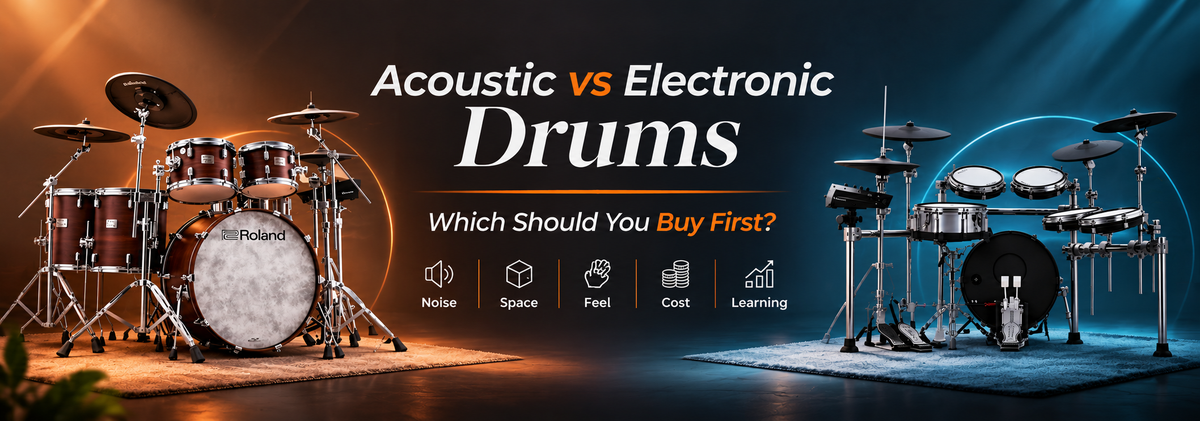
Acoustic vs Electronic Drums: Which Should You Buy First?
Choose an acoustic drum kit if you have a room where volume isn't a problem. Choose an electronic kit if neighbors, family or space limit when and how loud you can play. Both will teach you to drum. The better choice is the one you'll be able to sit down at most days of the week.
That sounds simple, but it hides a few details that catch people out: electronic kits aren't silent, cheap acoustic kits can sound worse than cheap electronic ones, and there's a middle route most comparisons skip. This guide walks through each difference, then gives a quick way to decide.
If you're still learning what's in a kit, start with our drums and percussion instruments guide, then come back here.
The Short Answer by Situation
|
Your situation |
Better fit |
Why |
|
House with a basement, garage or spare room |
Acoustic |
Real dynamics and cymbal response from day one |
|
Apartment, condo or shared walls |
Electronic |
Play through headphones at any hour |
|
Young child just starting |
Either; electronic if noise matters |
A compact e-kit fits a bedroom and has built-in practice tools |
|
Want to join a band soon |
Acoustic, or electronic plus regular time on a real kit |
Most rehearsal rooms and venues use acoustic drums |
|
Home recording |
Electronic |
Records over USB or MIDI with no microphones |
|
Worship team or small stage |
Either |
Many churches use e-kits to control stage volume |
How Each Kind of Kit Makes Sound
An acoustic kit is purely mechanical. When the stick hits a drumhead, the head and the shell vibrate and push air. How hard you hit, where you hit and how the drum is tuned all change the sound.
An electronic kit uses pads with sensors called triggers. When you hit a pad, the trigger sends a signal to the drum module, the small control box mounted on the rack. The module plays back a recorded drum sound through headphones or a speaker. Better modules read how hard and where you hit, which is why they feel more expressive.
That difference explains almost every pro and con below.
Noise: The Deciding Factor for Most Buyers
Acoustic drums are loud enough that hearing protection is a sensible habit, even in a large room. There's no volume knob. You can soften them with low-volume cymbals, mesh practice heads or muffling, but you can't make them quiet.
Electronic drums move the sound into your headphones. What's left in the room is the tap of sticks on pads. Mesh heads are quieter than rubber pads, and the cymbal pads usually make the most acoustic noise.
Keep in mind that the bass drum pedal is the one sound headphones can't hide. Each kick sends a thump into the floor, and people below you hear it more than people next door. If you live upstairs from someone, plan on a drum riser or a platform of dense foam or rubber under the kit. Our guide to quiet drum practice in an apartment covers the options.

Space and Setup
A standard five-piece acoustic kit with cymbal stands and a throne needs roughly the floor area of a small rug, plus elbow room. You also need somewhere to store cases if you move it.
Most electronic kits mount every pad on a single rack. Many fold up against a wall when you're done. That alone makes them practical in bedrooms and small living rooms.
Feel and Playability
This is where acoustic drums still lead. A real drumhead gives back natural rebound, and real cymbals swell, sustain and react to exactly where you strike them. You learn to control volume with your hands, which is a core drumming skill.
Electronic kits have closed the gap, especially at the drums. Mesh heads let you adjust tension and feel springy, close to an acoustic head. Cymbal pads are the weakest point: they're smaller, they don't swing the same way, and choking or swelling a cymbal feels different.
Sound Options
An acoustic kit has one voice, shaped by its tuning, heads and cymbals. To change it, you change hardware.
An electronic module holds dozens of kits, from a dry jazz kit to a big rock kit to electronic sounds. That variety is fun, and it helps when you're playing along with different songs, but it isn't a reason on its own to choose electronic.
Practice Features
Most electronic modules include a metronome, play-along songs, recording and coaching exercises that score your timing. Those tools genuinely help beginners keep practicing.
With an acoustic kit you add these yourself, starting with a metronome and a phone to record your playing.
Recording
Electronic kits are far simpler to record. Plug the module into a computer over USB, and you can record audio or MIDI straight into recording software.
Recording acoustic drums well takes several microphones, an audio interface and a decent-sounding room. It's rewarding, but it's a project.
Cost and Maintenance
Both types are sold at entry, mid and pro levels, so compare at the same level. Watch for two hidden costs.
On the acoustic side, the cheapest kits often ship with thin cymbals and basic heads. Replacing them is usually the first upgrade.
On the electronic side, check what's included. Some kits come without a throne, kick pedal or headphones, and you'll need all three.
Acoustic kits need new heads and occasional tuning. Electronic kits need little maintenance, but the module and cables are electronics, so keep them away from spilled drinks and heat.
The Third Option: A Low-Volume Acoustic Kit
Most comparisons skip this route. You can keep an acoustic kit and cut its volume dramatically with mesh practice heads on the drums and low-volume perforated cymbals. Add triggers and you can even send it to a module for headphone practice.
It doesn't sound like a real kit when you play this way, but it keeps the real hardware, the real setup and much of the feel. It suits families who want an acoustic kit for the future but need quiet now.
Is It Hard to Switch from Electronic to Acoustic?
Not if you plan for it. Players who learned only on an e-kit usually notice three things on their first acoustic kit: the drums are louder than they expected, cymbals react much more to touch, and the kit is laid out a little wider.
To make the switch easier:
- Set your e-kit pads at heights and angles close to a real kit.
- Practice dynamics on purpose. Play the same groove soft, medium and loud.
- Book time on an acoustic kit every few weeks, at a lesson, a rehearsal studio or a friend's place.
- Don't turn the module's sensitivity up to make soft playing louder. It hides weak strokes.

What to Look For When You Buy
For an electronic drum kit, check for mesh heads on at least the snare, a hi-hat with a real pedal or controller, a module with a headphone output and USB, and a kick pad sturdy enough for a real bass drum pedal. Add closed-back headphones so you hear the kit, not the room.
For an acoustic kit, check that it comes with stands, a kick pedal and a throne, or budget for them separately in our drum hardware section. Plan on upgrading the cymbals once you know you're sticking with it.
Frequently Asked Questions
Are electronic drums good for beginners?
Yes, electronic drums are a good choice for beginners, especially in homes where noise or space is limited. Built-in metronomes and practice modes help new players develop timing. Spend some time on an acoustic kit as well so you learn real dynamics.
Is it hard to switch from electronic to acoustic drums?
Switching from electronic to acoustic drums takes a short adjustment rather than relearning. Expect more volume, more sensitive cymbals and a slightly wider layout. Practicing dynamics on the e-kit and playing an acoustic kit occasionally makes the change smoother.
How loud are electronic drums?
Electronic drums are much quieter than acoustic drums, but they aren't silent. Mesh pads make a soft tap, rubber pads and cymbal pads are louder, and the kick pedal sends a thump through the floor.
Do electronic drums need an amp?
Electronic drums don't need an amp for practice, because headphones plug straight into the module. You do need an amplifier, a powered speaker or a PA to play out loud for other people.
Can I play electronic drums in an apartment?
Yes, electronic drums are the most practical kit for an apartment. Use headphones, and put the kit on a riser or a thick rubber or foam platform to reduce kick-pedal vibration for the neighbors below.
Are electronic drums easier to play?
Electronic drums can feel slightly easier at first because pads give more rebound and the layout is compact. The coordination and timing you need are the same on both kinds of kit.
Can you learn drums on an electronic kit?
Yes, you can learn drums on an electronic kit. Rhythm, coordination, reading and timing all carry over to acoustic drums.
The Bottom Line
Pick the kit your home and schedule will actually let you play. If that's acoustic, you'll get the most natural feel from the start. If it's electronic, you'll get far more practice time, and the skills transfer.
When you're ready to compare kits, browse electronic drum kits or the full drums and percussion range, and contact our team at 800-511-1322 if you want help matching a kit to your space.
Share:
Drums and Percussion Instruments: A Practical Guide for Every Player
Electronic Drum Kit Buying Guide